Beekeeping With Claude-Flow
Claude-Flow is not another AI coding assistant. It’s a substrate for multi-agent orchestration, built in Rust, and redefining how we build software

Claude-Flow is the most important AI development tool you've never heard of. Here's why it matters.
In an earlier post from this series, Reality Check: AI Isn't Replacing Software Engineers, I touched on how we're using Claude-Flow in development workflows. This post dives deeper into why Claude-Flow represents something fundamentally different. Not just another tool, but a substrate for AI-driven development.
As AI pioneer Andrew Ng emphasized in his May 2024 conversation with Ben Lorica, agentic workflows represent a paradigm shift, allowing AI to work iteratively with "huge improvement in performance" compared to single-shot LLM interactions. He describes entering an era of "agentic moments" where AI can autonomously plan and execute complex tasks. This post, part of our Beyond the Hype: AI Engineering series, explores how Claude-Flow, an open-source platform built by ruvnet, exemplifies this shift through intelligent agent swarms.
This isn't Copilot with extra features. It's not a VSCode forked LLM Wrapper with bolt-ons and polished branding. It's not LangChain stitched together with Python scripts. Claude-Flow is a substrate. And once you see it that way, you understand why it is so different from anything else in the market.
Why It’s Still Under the Radar
Claude-Flow has 7.1k+ GitHub stars, driven by Reuven Cohen, founder of Agentics Foundation along with a nascent open-source community, but it hasn't hit mainstream hype yet. That's because:
It is a runnable tool and an extensible substrate. You install it with npm, but extracting real value still requires engineering judgment and customization.
It's rough around the edges and demands real engineering judgment. There is no easy button.
It is community-driven, not venture-backed. No marketing team is blasting ads or sponsoring influencers.
This is exactly why it matters. Revolutionary technologies always look raw and under-explained in their early days. Claude-Flow hasn't been packaged for mass consumption because it's primarily frontier research being developed in the open, under MIT license largely by its single core developer Reuven. It's today a platform only for builders who can handle the rough edges. Transformative technologies often hide in plain sight, and don't exactly fit existing categories.
Claude-Flow: Why It's a Game-Changer for Multi-Agent AI
Claude-Flow fundamentally changes how we think about AI-assisted development. Instead of a single assistant suggesting code, you get an entire development team that can be orchestrated at scale.
What makes it different:
True Multi-Agent Orchestration: Not one AI, but coordinated swarms working in parallel. A queen agent delegates to specialized workers: one analyzing architecture, another writing code, another handling tests.
Not Sub-Agents: Claude Code sub-agents are short-lived helpers inside a single Claude session. Claude-Flow agents are persistent, role-based processes orchestrated locally, with namespaced memory and resumability across sessions.
Checks and Balances: In a swarm, agents constrain and cross-verify each other. While one may hallucinate, its output still has to integrate with the hive, lowering drift risk. Explicit QA agents can be added for even stronger governance.
Substrate, Not Just a Tool: You don't just use Claude-Flow, you build on top of it. It's infrastructure for the next generation of AI development workflows.
Local-First Intelligence: Core coordination and many utilities can run on your machine via Rust and MCP servers, before heavyweight reasoning is sent to Claude, batched for efficiency.
Ungated Creativity: The agents aren't constrained by safety rails designed for consumer products. This is raw power that requires engineering judgment.
Think of it as Kubernetes for AI orchestration, powerful for large projects but demanding real engineering judgment to manage effectively.
Swarms vs. Claude Code sub-agents
| Area | Swarm agents | Claude sub-agents |
|---|---|---|
| Lifetime | Can persist across sessions | Scoped to a single session |
| Orchestration | Local via MCP on your box | Inside Claude Code |
| Memory | Namespaced store you can query | Session context |
| Control | You own hooks and telemetry | Vendor managed |
| Best for | Repo-wide, multi-role workflows | Task decomposition in one session |
How Claude-Flow Relates to Frameworks (LangChain, CrewAI)
Some readers ask if Claude-Flow is like LangChain or CrewAI. The answer is no.
LangChain and CrewAI are orchestration frameworks - toolkits for building custom agents with chaining, data pipelines, and event hooks. They give you the pieces to construct deterministic, modeled workflows from scratch.
Claude-Flow is orchestration embodied. You get a living swarm of agents with coordination, memory, and MCP tooling already in place. Run it out of the box with a single prompt to "do the things." And because it's open source and modular, you can dig into the substrate to change how agents coordinate, swap modules, or extend the swarm.
You're not stitching chains together - you're directing a living organism.
Think of it this way: Agent frameworks are like inheriting a workshop full of tools. Claude-Flow is like inheriting a brain that already knows how to think.
Capabilities
Hive-mind coordination with queen and workers
WebAssembly-accelerated neural components
80+ MCP tools for orchestration, memory, GitHub, automation
Persistent, queryable SQLite memory scoped to a hive
Hooks system for pre and post operation workflows
GitHub workflows for issues and pull request management
Early, constrained runs report ~80% on SWE-Bench; treat as directional, not a guarantee
Notable token savings from task decomposition and batching
Reality checks
Observability: thin by default. You’ll either poll SQLite/logs or build an MCP→HTTP bridge to emit telemetry.
Execution context: MCP tools run in Claude’s environment, not your Node process. External monitors need a bridge or DB polling.
GNN: real on the roadmap; not production today.
Autonomy: without hard boundaries, it will optimize “creatively” and surprise you.
Where It Shines
Repo-wide refactors: Split by package, run codemods, synthesize tests, gate with a reviewer agent before merge.
Research → brief: Researcher compiles sources, analyst tables findings, writer drafts, fact-checker verifies claims and links.
Incident triage: Log-miner clusters errors, hypothesis agent proposes root cause, remediator suggests patch, post-mortem writer compiles the report.
Standards upgrades: Mapper enumerates call sites, transformer applies the new API, reviewer checks behavior parity.
Greenfield scaffolds: Planner sketches architecture, coder generates modules, tester builds fixtures, docs agent explains decisions.
Data→Insight pipelines: Ingestor fetches data, cleaner normalizes, analyst runs stats, narrator produces an exec-readable summary.
Compliance & QA sweeps: Policy agent encodes rules, scanner flags violations, fixer proposes remediations, auditor signs off.
The Architecture: A Deep Dive
Claude-Flow's power comes from its layered architecture.
Performance Layer: Rust and WASM SIMD
Claude-Flow is forged in Rust, compiled to WebAssembly, and optimized with Single Instruction, Multiple Data (SIMD). This delivers near-native performance in environments typically bottlenecked by overhead.
The open-source architecture includes:
ruv-FANN (crates.io): A memory-safe neural network library modernizing the legacy FANN library
ruv-swarm-wasm: WebAssembly neural network orchestration with SIMD optimization
ruv-swarm source: The core swarm implementation in Rust
The project has active development with NPM packages like claude-flow@alpha and ruv-swarm for those who want to dive into the code.
Intelligence Layer: Hive-Mind and GNN
Claude-Flow organizes agents in a hive-mind structure. A "queen" agent coordinates specialized workers. The system is building toward Graph Neural Network (GNN) capabilities to map your codebase as a living graph.
The system is designed to:
Analyze relationships between code domains
Calculate cohesion scores
Identify cross-domain dependencies and hidden bottlenecks
Propose boundary optimizations to reduce coupling
Protocol Layer: MCP
The Model Context Protocol (MCP) is a standardized framework for managing agent communication and orchestration. Think of it as APIs for agents.
Claude-Flow ships with 87+ MCP tools covering:
Agent management (spawn, terminate, monitor)
Task orchestration and workflows
Memory management and queries
Real-time metrics and system health
GitHub repository, pull request, and issue management
These tools form an orchestration language, enabling automation of complex development lifecycles. And they are installed and configured automatically from the single npx command: npx claude-flow@alpha init --force
Memory Layer: Persistent SQLite Brain
Unlike most tools that simply attach a vector database, Claude-Flow’s memory is namespaced and tied to the hive. Context, interactions, and architectural insights are stored in SQLite in a way that can be queried, resumed, and extended across the life of a swarm. This makes memory part of orchestration itself, not just a storage bolt-on. It allows a hive to pause, pick up later, or run in parallel without losing continuity.
This enables:
Learning from past interactions
Maintaining context across sessions
Collective hive-mind knowledge
Long-term trend analysis
Power and Risk
Don't ask it to do small things, with defaults.
I once gave Claude Flow a laundry list of "small tasks", including "add a small India flag icon to a corporate landing page." What it actually did was translate the entire site into Tamil, created a section on how Tamil Nadu is the new Silicon Valley of India, and generated blog posts and images to support the claim.
This was Claude-Flow executing creatively without constraints. To prevent runaway execution, always define clear task boundaries. Specify which files can be touched, limit the scope of changes, and require approval checkpoints before merges. Claude-Flow moves fast, but it must be contained.
Monitoring: Out of the box there is no rich, external dashboard. In practice you either read the SQLite memory and logs, or add an MCP tool that emits telemetry to a local endpoint so you can visualize agents, tasks, and tool calls.
Practical Tips
Define Requirements Up Front: Treat your prompt like a lightweight PRD (Product Requirements Document). A clear spec (user stories, acceptance criteria, boundaries) acts as the contract the swarm must converge around. Without it, the hive will still move, but not necessarily toward the architecture you want. Drop it in
./prd.mdinstead of directly in the swarm prompt.Context in Code: I keep my context in more human, non-proprietary form like MDs and directives in code (comments/agent directives). This keeps context human-readable, version-controlled, and not locked in proprietary stores.
Git Hygiene: I gitignore Claude-Flow scaffolding. My main repo stays clean, and I bring in AI-generated context only when it makes sense.
Claude-Flow shines for deep architectural analysis, complex refactors, big bang code-starts, and research-heavy transformations. But it requires thoughtful setup to avoid chaos.
I sometimes like to use this workflow for major transformations that keeps the workspace clean:
Move all existing code to
./inputCreate
./outputfor transformed codeCreate
./workfor Claude-Flow's intermediate thinking (scratch)Drop a
prd.mdin root with clear instructions: "source is in ./input, do X, put results in ./output"
This separation prevents scaffolding from mixing with project code and gives Flow clear visibility into before/after states. When the transformation looks good, cleanup is simple: delete input and scaffolding, move output to root, commit. One solid transformation, no cruft.
For quick starts:
npx claude-flow@alpha init --forcesets up MCP with 87 tools and an optimized Claude config.Add
--dangerously-skip-permissionsfor faster execution (only on dedicated build machines or Docker).Then just
npx claude-flow@alpha swarm "./prd.md" --claudeto launch the swarm with Claude Code orchestrating.The last flag tells Claude Code to build the swarm call, and simply setting
./prd.mdin the instructions is sufficient for Claud Code to build the swarm instructions.
This pattern lets me harness its power while keeping my workflows portable and transparent, but the real power of a substrate is that you can develop whatever workflow fits your needs. Claude-Flow adapts to how you think, not the other way around.### How Claude-Flow Relates to Frameworks (LangChain, CrewAI)
Costs
Claude-Flow itself is Open Source, runs locally, and free to use under MIT. However given it uses Claude Code, you will need to have either a subscription or an API key. I recommend the $200 MAX subscription. Using getAsterisk/opcode, formerly "Claudia", I see what just a couple projects "would be" under API usage:
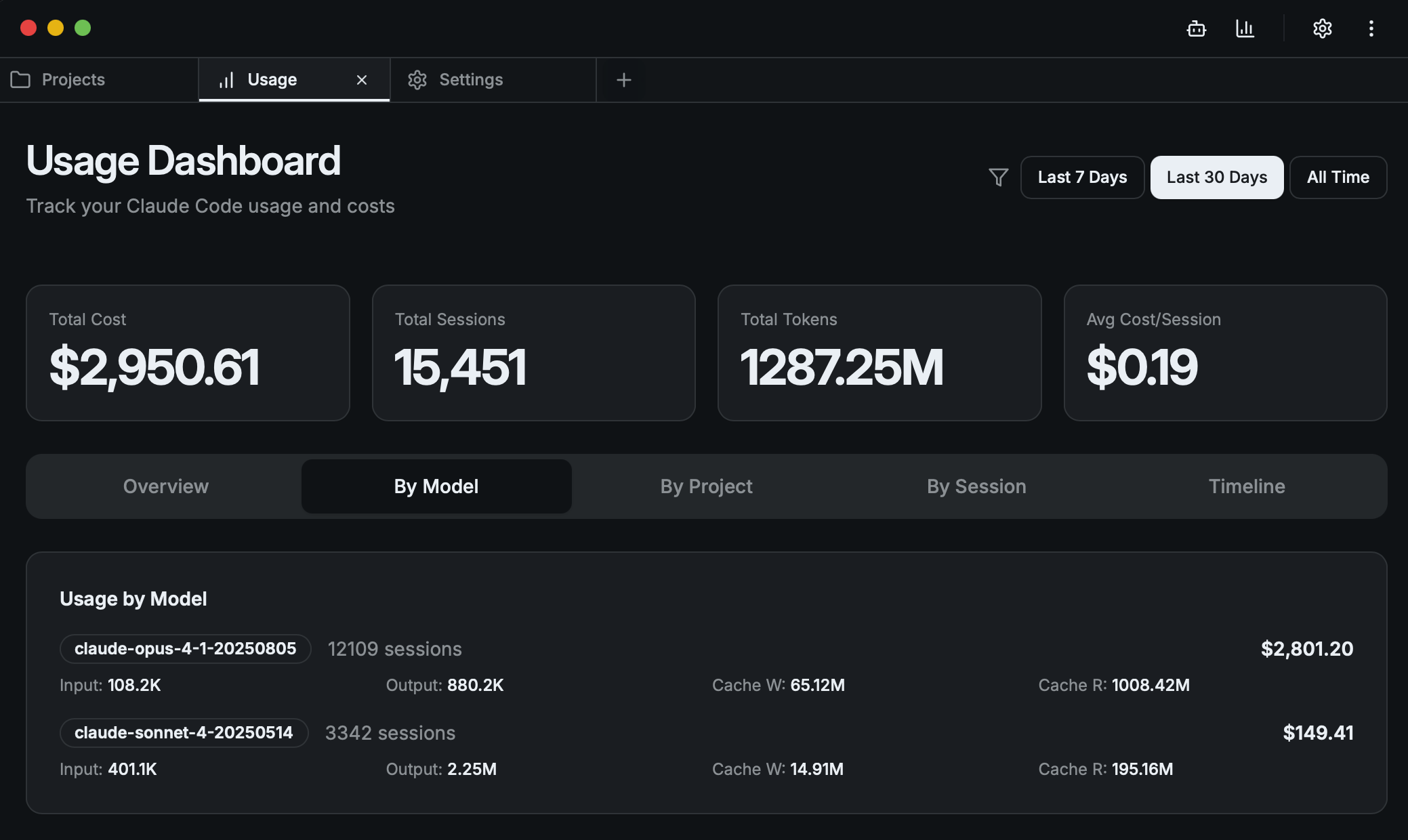
Thankfully I don't have to pay that. I pay $200/mo flat rate under Claude Max.
The Future: From Substrate to Ecosystem
The R&D foundation is solid, and continues to improve. Now two parallel tracks are inevitable:
Track 1: Maturing the Core Claude-Flow needs to evolve from alpha substrate to production-ready platform:
Stability hardening and error boundaries
Developer-friendly UIs beyond terminal interfaces
Enterprise features: audit logs, permissions, SLAs
Track 2: The Ecosystem Layer This is where it gets interesting. Claude-Flow as a substrate enables entirely new product categories:
Dockerized API Services: Manus-style cloud agents, but running your own swarms with full control
GitHub Command Centers: Natural language issue/PR management backed by agent swarms that actually understand your codebase
Domain-Specific Platforms: Vertical products for legal docs, financial modeling, game development with specialized agent configurations
The architecture is here. Claude-Flow will spawn an ecosystem of agent-native products.
Engineers will continue to lead development for the foreseeable future, while substrates like Claude-Flow are redefining how software is built. The shift is here, and it is worth paying attention to.
Join the Conversation
About 7Sigma
7Sigma was founded to close the gap between strategy and execution. We partner with companies to shape product, innovation, technology, and teams. Not as outsiders, but as embedded builders.
From fractional CTO roles to co-founding ventures, we bring cross-domain depth: architecture, compliance, AI integration, and system design. We don't add intermediaries. We remove them.
We help organizations move from idea → execution → scale with clarity intact.
Don't scale your team, scale your thinking.
Learn more at 7sigma.io
Reviewers:
Dr. Rüdiger Berlich
Authored by: Robert Christian, Founder at 7Sigma
© 2025 7Sigma Partners LLC


